Portugal and Korean Republic have collaborated to issue the stamp features the war-ship. This issue consist of two stamps and released on April 15, 2011.
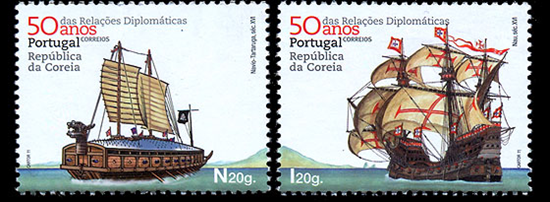 The Turtle Ship
As a pioneering type of war ship of the Joseon Dynasty, the Turtle Ship was conceived in 1592 by Admiral Yi Sun-Shin who anticipated a Japanese invasion. The shape and tactical capabilities portrayed by Admiral Yi Sun-Shin himself are as follows:
“Wooden planks are laid on the upper deck of the ship, and on those planks, narrow cross-shaped ramps are placed to enable people to walk through, with sharp spear heads and spikes lodged on the rest of ship’s surface. The bow of the ship is shaped like a head of a dragon, while the stern takes the shape of the tail of a turtle. There are gun ports fore and aft and also six gun ports port and starboard respectively, where large projectiles are loaded and fired. When enemy soldiers attempt to board the vessel, a straw mat is placed over the blades on the back of the Turtle Ship so they cannot be seen. The Turtle Ship will hereinafter be in the vanguard of naval warfare, with its sharp spear heads and spikes stopping enemy soldiers from climbing onto its back. When enemy ships try to siege the Turtle Ship, it can fire its cannons simultaneously fore and aft, port and starboard.”
Yi Sun-Shin, Korea’s venerated admiral, utilized the Turtle Ship as an assault ship and gained victory in 23 naval battles over 7 years under the spirit of “If you want to live through combat, you will certainly die. But if you want to die at combat, you will certainly live.” The Korean people take immense pride in both Admiral Yi Sun-Shin and his indomitable Turtle Ship.
THE PORTUGUESE NAU
The age of the Caravels came to an end when Cap Bojador was rounded in 1487. The prevailing Atlantic winds and currents that enabled this feat, rendered far-away voyages feasible and justified the choice of the Nau as a more suitable vessel for the Cape route. The reason was that it had much greater DW tonnage, it could carry more cargo thus enable larger profits and also more provisions, a larger crew, passengers, as well as cannons for protection against the corsairs. Generally, the Nau had 3 decks, 3 masts (2 fitted with square sails and one with a Latin sail), a forecastle and an aftercastle, and a carrying capacity varying between 120 and 1200 tuns.
Naus that sailed on the so called “Carreira da Índia” (India route) played a leading role on the annual trade route between Lisbon and Goa, initiated with the discovery of the maritime route to India, a voyage that Valignano in 1574 described as being “the longest and most trying voyage there is”. A true odyssey, which documents, in a dramatic way, our “história trágico-marítima” (“tragic history of the sea”), a narrative of dramatic shipwrecks occurred in those times.


