Showing posts with label South Korea. Show all posts

Sunday, November 4, 2012

The 50th Anniversary of Korea – Australia Diplomatic Ties


To celebrate the 50th Anniversary of Diplomatic ties between Korea and Australia , both post authorities have issued a set of two stamps feature their  traditional musicians  on  October 28,  2011. The musical instrument have been depicted on stamps are haegeum  and  didgeridoo.

AU072-11-horz
Haegeum musician
The haegeum is a traditional Korean string instrument, resembling a fiddle. It has a rodlike neck, a hollow wooden soundbox, and two silk strings, and is held vertically on the knee of the performer and played with a bow.The haegeum is one of the most widely used instruments in Korean music.

Thursday, October 25, 2012

Philakorea 2009 - 24th Asian International Stamp Exhibition


The PHILAKOREA 2009 24th Asian International Stamp Exhibition  held from July 30 to August 4, 2009 at the Indian Hall, COEX (Convention and Exhibition Center), Seoul. PHILAKOREA 2009 marks the first hosting of the Asian international stamp exhibition by Korea. This Exhibition have been  participated by about 30 countries under the theme of "Humans, Nature, and Stamps," and presenting not only stamp-related programs . PHILAKOREA 2009 was designed to serve as a festival for all family members to enjoy and explore Asia's stamp culture.

http://d2cdm2jef6kgc7.cloudfront.net/stamps/2009/KR/KR028.09.jpghttp://d2cdm2jef6kgc7.cloudfront.net/stamps/2009/KR/KR029.09.jpg
Ssangchido
The stamps issued to commemorate PHILAKOREA 2009  feature several Yeongmohwa (a type of drawing that depicts birds and animals - notable paintings that are representative of Korea's 19th century paintings), such as :  Ssangchido , Hochido, Jurodo and Yuapdo. Along with these commemorative stamps, 4 miniature sheets and a commemorative postcard that shows the emblem and mascot are also issued.

Thursday, March 8, 2012

The 50th Anniversary of Korea - Thailand Diplomatic Relations.


On  1st  October 2008 , Korea Post issued the stamp set for celebrating  the 50th Anniversary of Korea-Thailand Relations. The issue comprises of two postage stamps depicts the palace of each countries respectively.Thailand  presents the Grand Palace  meanwhile Korea Republic presents Changdeokgung Palace.

image
Grand Palace (Thailand)
The Grand Palace is a complex of buildings at the heart of Bangkok, Thailand. The palace has been the official residence of the Kings of Siam (and later Thailand) since 1782. The king, his court and his royal government were based on the grounds of the palace until 1925. The present monarch, King Bhumibol Adulyadej (Rama IX), currently resides at Chitralada Palace, but the Grand Palace is still used for official events. Several royal ceremonies and state functions are held within the walls of the palace every year.

image
Changdeokgung Palace (Korea)
Changdeokgung was the second palace after Gyeongbokgung which had been established in 1395 as a primary palace.Changdeokgung, also known as Changdeokgung Palace  is set within a large park in Jongno-gu, Seoul, South Korea. It is one of the "Five Grand Palaces" built by the kings of the Joseon Dynasty. The literal meaning of Changdeokgung  is "Palace of Prospering Virtue".Changdeokgung was the most favored palace of many princes of the Joseon Dynasty. (Resources information were taken from Wikipedia)

Sunday, November 6, 2011

Joint issues Portugal - Korean Republic

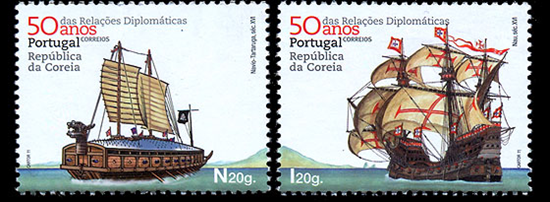
Portugal  and Korean Republic have collaborated to issue the stamp features the war-ship. This issue consist of two stamps and released on  April 15, 2011.
image


The Turtle Ship
 
As a pioneering type of war ship of the Joseon Dynasty, the Turtle Ship was conceived in 1592 by Admiral Yi Sun-Shin​ who anticipated a Japanese invasion. The shape and tactical capabilities portrayed by Admiral Yi Sun-Shin himself are as follows:
“Wooden planks are laid on the upper deck of the ship, and on those planks, narrow cross-shaped ramps are placed to enable people to walk through, with sharp spear heads and spikes lodged on the rest of ship’s surface. The bow of the ship is shaped like a head of a dragon, while the stern takes the shape of the tail of a turtle. There are gun ports fore and aft and also six gun ports port and starboard respectively, where large projectiles are loaded and fired. When enemy soldiers attempt to board the vessel, a straw mat is placed over the blades on the back of the Turtle Ship so they cannot be seen. The Turtle Ship will hereinafter be in the vanguard of naval  warfare, with its sharp spear heads and spikes stopping enemy soldiers from climbing onto its back. When enemy ships try to siege the Turtle Ship, it can fire its cannons simultaneously fore and aft, port and starboard.” 
 
Yi Sun-Shin, Korea’s venerated admiral, utilized the Turtle Ship as an assault ship and gained victory in 23 naval battles over 7 years under the spirit of “If you want to live through combat, you will certainly die. But if you want to die at combat, you will certainly live.” The Korean people take immense pride in both Admiral Yi Sun-Shin and his indomitable Turtle Ship. 
 

THE PORTUGUESE NAU 
 
The age of the Caravels came to an end when Cap Bojador was rounded in 1487. The prevailing Atlantic winds and currents that enabled this feat, rendered far-away voyages feasible and justified the choice of the Nau as a more suitable vessel for the Cape route. The reason was that it had much greater DW tonnage, it could carry more cargo thus enable larger profits and also more provisions, a larger crew, passengers, as well as cannons for protection against the corsairs. Generally, the Nau had 3 decks, 3 masts (2 fitted with square sails and one with a Latin sail), a forecastle and an aftercastle, and a carrying capacity varying between 120 and 1200 tuns. 
 
Naus that sailed on the so called “Carreira da Índia” (India route) played a leading role on the annual trade route between Lisbon and Goa, initiated with the discovery of the maritime route to India, a voyage that Valignano in 1574 described as being “the longest and most trying voyage there is”. A true odyssey, which documents, in a dramatic way, our “história trágico-marítima” (“tragic history of the sea”), a narrative of dramatic shipwrecks occurred in those times. 

Related Posts Plugin for WordPress, Blogger...